- July 6, 2026
- by Shifline Team
- 9 minutes read
Why Cloud Workforce Management Software is the Future for Modern Businesses
The business environment today is fast-paced and efficiency in managing the employees is a necessity. In today’s world of hybrid working, multiple office locations, remote working and changing compliance regulations, the traditional approach to workforce management no longer applies. Organizations need solutions that provide the real-time visibility, automation and flexibility that are needed.
But with digital transformation in the workplace becoming more commonplace, cloud-based working solutions have become a critical component to running an effective organization. These save time and improve the experience of employees and provide business leaders with the correct information to make decisions.
What is Workforce Management (WFM) Software?
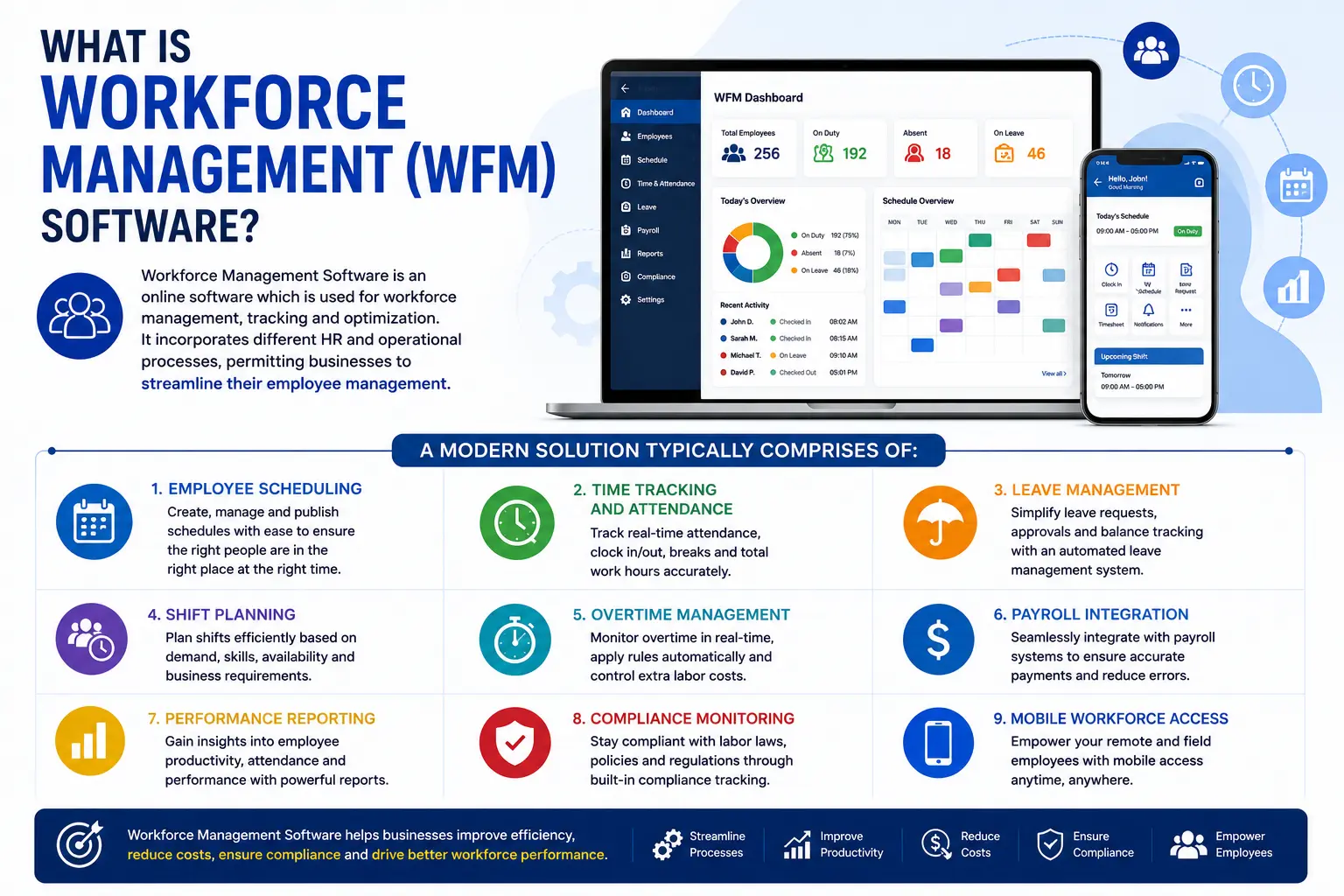
Workforce Management Software is an online software which is used for workforce management, tracking and optimization. It incorporates different HR and operational processes, permitting businesses to streamline their employee management.
A modern solution typically comprises of:
- Employee scheduling
- Time tracking and attendance
- Leave management
- Shift planning
- Overtime management
- Payroll integration
- Performance reporting
- Compliance monitoring
- Mobile workforce access
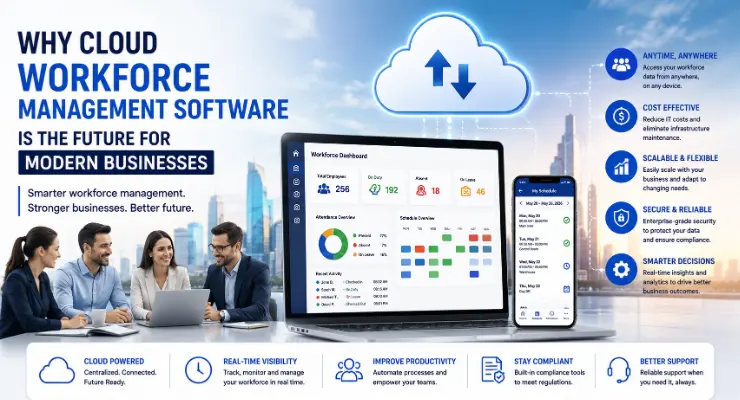
All workforce data is securely stored online with cloud-based software, so there is no need for costly servers or manual record keeping.
Organizations can no longer use paper-based schedules or spreadsheets to get a real-time picture of workforce operations to make informed decisions quickly.
Businesses are turning to cloud-based workforce management for the following reasons:
Workplace has been transformed over the last 10 years. For remote work, flexible scheduling, field employees and distributed teams, systems must be accessible from any location.
The cloud workforce management system has benefits that a software system cannot provide.
Anywhere, Anytime Access:
Using a laptop, tablet or smartphone, managers have the ability to approve leave requests, view attendance, post schedules and track employee activity.
Employees can also:
- View schedules
- Request leave
- Check attendance records
- Swap shifts
- Receive instant notifications
This accessibility enhances communication and cuts off delays.
Real-Time Workforce Visibility:
Cloud solutions keep information current in real-time.
Managers no longer have to wait until the end of the day to check in who has left or who is still there. Instead, they are provided with live dashboards which display:
- Active employees
- Late arrivals
- Absences
- Overtime
- Shift coverage
This allows quicker decision-making in case of unforeseen staffing changes.
Reduced IT Costs:
Traditional software may need to be:
- Dedicated servers
- Manual upgrades
- Hardware maintenance
- IT support
The majority of these costs are avoided in cloud platforms since it is the provider’s responsibility to take care of the software updates, backups, and maintenance.
Companies can concentrate on the business rather than infrastructure.
The use of workforce management software can significantly boost business productivity.
The key to productivity is getting the right people in the right place at the right time.
Cloud Workforce Management Software can help in making this happen by means of automation and proper planning.
Smarter Employee Scheduling:
Manual scheduling can lead to scheduling conflicts, understaffing and overtime.
Cloud scheduling automatically takes into account:
- Employee availability
- Skills
- Certifications
- Shift preferences
- Labor laws
Managers spend less time preparing schedules and have adequate staffing.
Better Attendance Tracking:
Manual attendance systems can be prone to mistakes, which then impact payroll and reporting.
Cloud solutions come with:
- Biometric devices
- Mobile GPS check-ins
- Face recognition
- QR code attendance
- Digital kiosks
Attendance is logged automatically, eliminating payroll inaccuracies.
Automated Leave Management:
- Employees request and submit leaves via online instead of emails and paper forms.
- Requests are instantaneously approved with notifications to the managers.
- Balances are updated automatically in leaves, which reduces HR workload.
Reduced Administrative Tasks:
Routine activities like:
- Shift allocation
- Attendance verification
- Payroll preparation
- Overtime calculations
- Report generation
All of these things can be automated, which gives HR teams more time to concentrate on employee involvement and strategic initiatives.
Here’s why HR Teams are choosing Cloud Workforce Management:
Today’s HR department should be doing much more than keeping employee records.
Cloud Workforce Management solutions enable HR professionals to be strategic business partners rather than spending hours on repetitive HR administrative tasks.
Centralized Employee Information:
All employee records are kept in one safe data source.
HR teams can easily access:
- Personal information
- Attendance history
- Leave balances
- Shift schedules
- Performance records
- Employment documents
Everything centralized ensures accuracy and less paperwork.
Faster Payroll Preparation:
Accurate attendance and overtime data is crucial for payroll.
Cloud platforms provide automatic calculations for:
- Working hours
- Overtime
- Late arrivals
- Leave deductions
- Holiday pay
Payroll staff dedicate less time to painstakingly checking data and correcting errors.
Better Compliance:
There are ongoing changes in employment rules across sectors.
Cloud software aids organisations in staying compliant by keeping:
- Attendance records
- Working hour limits
- Overtime policies
- Leave policies
- Audit trails
This minimizes compliance risks and makes audits easier.
Data-Driven Decision Making:
Rather than on assumptions, HR managers can use dashboards and reports to gain valuable insights about their workforce.
They can identify:
- High absenteeism
- Overtime trends
- Employee utilization
- Staffing shortages
- Workforce costs
These insights help to do smarter workforce planning.
Cloud Workforce Management is Perfect for a Growing Business:
The more a business grows, the more complex the work force.
Spreadsheets become more challenging to manage as you add more offices, warehouses, retail locations, or project locations.
Cloud software scales with the organization, with no significant investment in infrastructure.
A company has or does not have the following:
- 50 employees
- 500 employees
- 5,000 employees
Workforce operations can be efficiently supported by the same cloud platform.
This scalability makes cloud technology perfect for businesses that have long-term growth in mind.
Workforce Management Software’s Industry Applications:
Cloud Workforce Management Software is suitable for different types of organizations from various fields.
Security Companies:
Providers of security services arrange for multiple locations of clients, rotation of shifts, round the clock coverage.
When used in conjunction with security guard rostering software, managers can:
- Assign guards automatically
- Monitor attendance
- Quickly substitute for missing guards
- Track shift completion
- Reduce scheduling conflicts
This helps to enhance the quality of service and reduces the impact on service operations.
Healthcare:
Hospitals and clinics need to be staffed round-the-clock.
Cloud workforce systems facilitate the scheduling of doctors, nurses, technicians, administrative staff and ensure adherence to working hour regulations.
Retail:
Retail operations have a tendency of having peaks and valleys in their staffing needs.
Cloud scheduling optimizes employee shifts with respect to the busiest shopping times, and it also cuts down on unnecessary overtime.
Manufacturing:
Manufacturers depend on shift working.
Cloud systems help optimize production planning and ensure that production lines are adequately staffed while minimizing the costs of overtime across the production line.
Facility Services:
Real-time scheduling, mobile attendance and workforce tracking on multiple client locations help cleaning, maintenance and field service companies.
Integration Makes Workforce Management Even More Powerful:
Businesses nowadays do not depend upon a stand-alone software application.
Cloud platforms seamlessly connect with:
- HR software
- Payroll systems
- ERP platforms
- Visitor management systems
- Access control systems
- Accounting software
- Mobile applications
These connections help eliminate redundant data entry and boost efficiency.
Organizations achieve a single seamless digital ecosystem rather than multiple stand-alone systems.
Security and Reliability in the Cloud:
One of the first concerns that many organisations have is where to store workforce data in the cloud.
But, a good cloud service provider will put a lot of effort into security technology—which can be more advanced than what a business can do in-house.
Modern cloud platforms provide:
- Data encryption
- Multi-factor authentication
- Automatic backups
- Disaster recovery
- Role-based access control
- Continuous monitoring
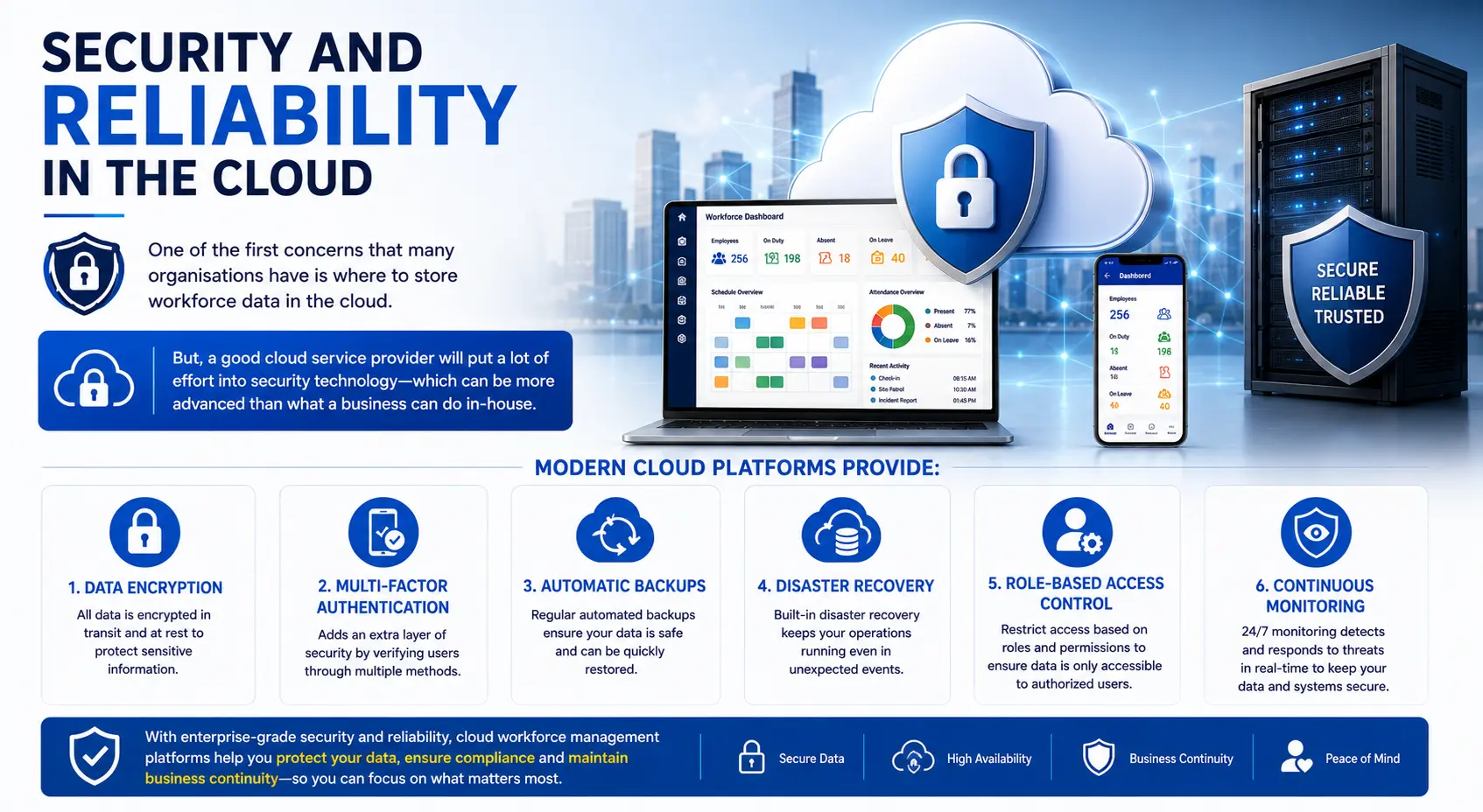
This helps to safeguard confidential employee data and maintain continuity of operations.
The Future of Workforce Management:
AI and automation are changing the way work is done.
The cloud platforms of the future will come to increasingly provide:
- AI-powered scheduling
- Predictive staffing
- Workforce demand forecasting
- Automated compliance monitoring
- Intelligent overtime optimization
- Employee self-service assistants
Today, organizations that adopt cloud technology will be better prepared for these innovations.
Businesses will no longer have to respond to workforce problems, but will instead be able to structure workforces, cut costs and keep staff happy based on predictions derived from predictive analytics.
Selecting the right Workforce Management Software:
Not all solutions have the same functionality.
In assessing a cloud workforce management system, companies should look for:
- Ease of use
- Mobile accessibility
- Scheduling flexibility
- Attendance automation
- Payroll integration
- Compliance features
- Reporting capabilities
- Cloud security
- Scalability
- Customer support
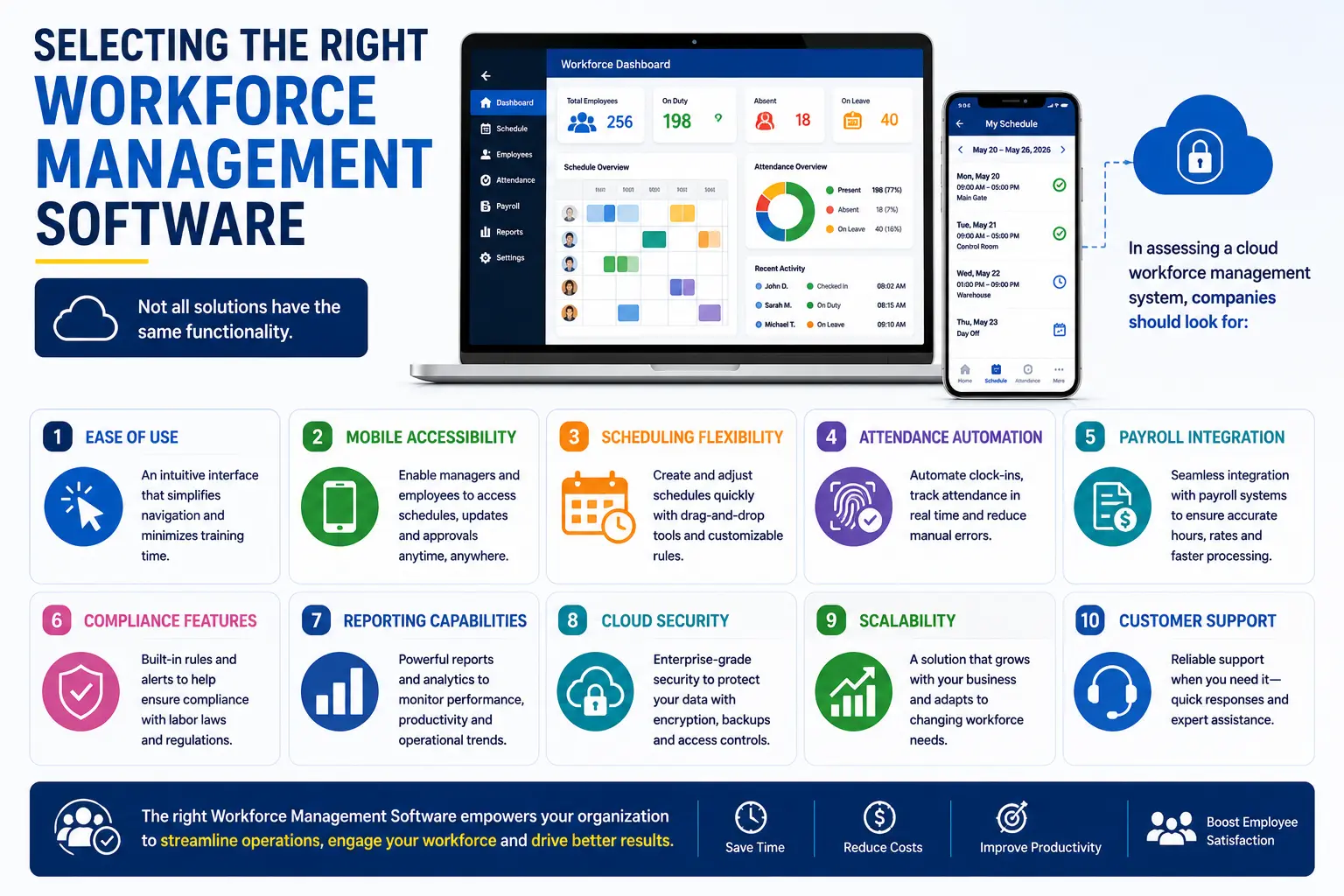
When software is chosen that fits with the present and future business requirements, it will have long lasting value.
Conclusion:
The workplace is constantly evolving and businesses must have technology that evolves, to address the changing needs of the workforce. Cloud Workforce Management Software provides organizations with flexibility, automation, and visibility, allowing them to effectively manage their workforce in the digital world.
Cloud solutions can simplify manual processes, improve accuracy at each and every phase of workforce, from more intelligent scheduling and attendance management to automated payroll preparation and compliance management.
Frequently asked questions
Cloud Workforce Management Software is flexible, automated, and provides real-time workforce visibility. It allows companies to handle employee scheduling, attendance, payroll, compliance and reporting anywhere, and saves on administrative tasks and boosts operational efficiency.
Cloud systems make it easier for people to work remotely, handle HR-related repetitive tasks, cut down on infrastructure expenses, make employees more visible, and allow access to employee data on real-time from various locations, making them more appealing to modern businesses.
Cloud Software increases productivity by automating the scheduling, attendance tracking, leave management, payroll preparation and workforce reporting. Administrative work for managers is reduced and more time is devoted to business optimization.
Cloud workforce management software integrates employee data, streamlines payroll processing, automates leave and attendance tracking, ensures adherence to regulations, and offers workforce analytics to guide HR decision-making.